

Silicate Marble Polishing in West Bengal
Silicate treatment is what gives marble a wet, deep gloss instead of a thin surface shine. The chemical reacts with the calcium in the stone and hardens the top layer, so the finish holds through mopping and footfall far longer than plain polishing. Work in West Bengal is planned as a scheduled visit: the crew and machines travel together on a fixed date, and the rate is written down after the floor is seen in person or from clear photos.
- Free inspection and test patch
- Masking of walls, skirting and furniture edges
- Wet sanding through the grit sequence
- Slurry vacuumed as work proceeds
At a glance
- Sil200 / Sil800
- Wet-look gloss
- Applied after polishing
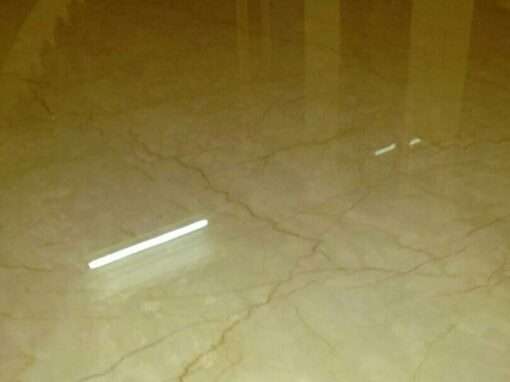
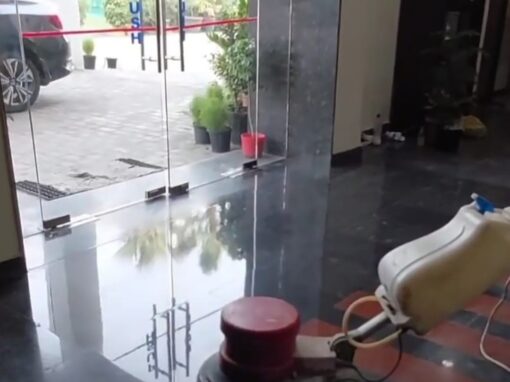
A real before and after photo is added here for the strongest result.
What is included in silicate marble polishing
- Wet sanding through the grit sequence
- Slurry vacuumed as work proceeds
- Damage and joint treatment where found
- Polishing after sanding on request
- Wash-down of the whole area
- Care advice for the first week
- Free inspection and test patch
- Masking of walls, skirting and furniture edges
What each surface needs
| Problem | Wet sanding effect | Outcome |
|---|---|---|
| Grey mop haze | Strips the residue layer | True stone colour returns |
| Old wax and coatings | Fully removed | Surface ready for polish |
| Light scratches | Ground out in stages | Even surface |
| Paint, POP and cement spots | Removed without acid | Clean stone |
Every surface is tested on a hidden patch before work starts, so you see the result before committing to the whole floor.
How the job runs
- Inspection and test patch (free)
- Masking and water containment
- Wet sanding in grit stages
- Slurry vacuumed and area washed
- Handover with finish options
Silicate Marble Polishing rates in West Bengal
| Work | Guide band | Notes |
|---|---|---|
| Wet sanding only | Rs 5-15 per sq ft | Residue removal |
| Wet sanding plus polishing | Rs 15-25 per sq ft | Dull floors |
| Sanding, grinding and polish | Rs 25-35 per sq ft | Damage and lippage |
| Coating after sanding | Quoted after inspection | Protection |
Rates depend on surface type, damage depth, area and access. The figure is written down before work begins.
The process, step by step
- Site inspection, gloss reading and hidden test patch
- Masking of skirting, fittings, doors and furniture edges
- Residue and old polish stripping where present
- Grinding if lippage or deep damage is found
- Progressive polishing through the grit sequence
- Optional silicate, crystallisation, epoxy or nano finish
- Edge and corner hand work
- Wash-down, walkthrough and care guidance
Each stage is completed on the whole area before the next one starts, so the floor never ends up with a bright patch next to an unfinished section.
Weight and load matter on upper floors and terraces. Where a slab has been laid over a void or a lightweight screed, we reduce machine weight and speed rather than risk cracking the base.
Team composition is consistent: a supervisor plus two machine operators on standard jobs, with additional hands for staircases, multiple floors or tight access. The same supervisor stays with the job start to finish.
The written rate is the final amount for the agreed scope. If we open the floor and find something the inspection could not show, we stop and re-quote with you before continuing, not after.
Why clients book us
- Test patch shown before the full job
- One team for sanding, grinding and polishing
- 12 years of marble work
- Wet method keeps dust out of the house
Serving West Bengal and nearby areas
West Bengal jobs are booked as a fixed visit batch, so travel is planned into the date instead of being added as a surprise. Work in West Bengal is planned as a scheduled visit: the crew and machines travel together on a fixed date, and the rate is written down after the floor is seen in person or from clear photos. Inspections are booked within 24-48 hours and most jobs take 1-2 days. Call 86070 01043 or WhatsApp photos of your floor for an indicative rate.
Silicate Marble Polishing - common questions
Does wet sanding remove a lot of stone?
It removes the coating and the damaged top layer only. Deep lippage needs grinding first, which we identify during inspection.
How messy is it?
We mask surfaces and vacuum slurry as we work, then wash the area before handover. Your furniture and curtains do not end up coated in dust.
Can it be done room by room?
Yes. Most clients do one or two rooms at a time, and dry paths are kept so the house stays usable.
Why wet sanding instead of dry?
Because dust control matters in occupied homes. Water carries the residue away and keeps the surface cool, which protects the stone from heat marks.
How long does each step take?
As a guide, preparation is under an hour, grinding runs 25-40 minutes per 100 sq ft, polishing 15-25 minutes, and finishing plus clean-up about an hour. Bigger areas are scheduled over more days.
Can steps be skipped to save money?
Not safely. Skipping grit stages is the most common shortcut and shows up as scratch haze within weeks. If you want to reduce cost, reduce the area covered this cycle, not the process.
Do you work in one room or the whole floor at a time?
Room by room if you are living in, whole floor if the house is empty, which produces a more even finish because lighting and drying are consistent.