
Silicate Marble Polishing in Tripura
Silicate treatment is what gives marble a wet, deep gloss instead of a thin surface shine. The chemical reacts with the calcium in the stone and hardens the top layer, so the finish holds through mopping and footfall far longer than plain polishing. Work in Tripura is planned as a scheduled visit: the crew and machines travel together on a fixed date, and the rate is written down after the floor is seen in person or from clear photos.
- Free inspection measuring lippage and slab thickness
- Tapping test for hollow slabs
- Wet grinding to keep dust down indoors
- Coarse to fine grit sequence with no skipped stages
At a glance
- Sil200 / Sil800
- Wet-look gloss
- Applied after polishing
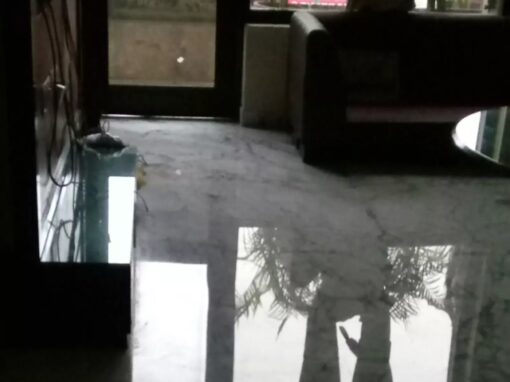
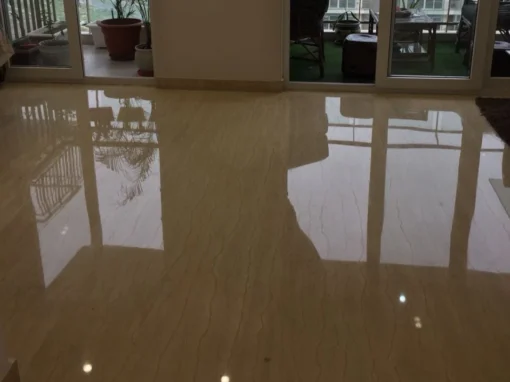
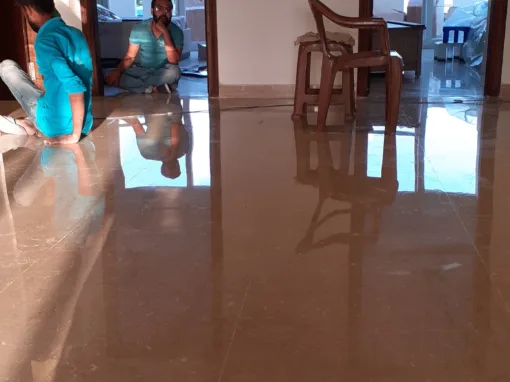
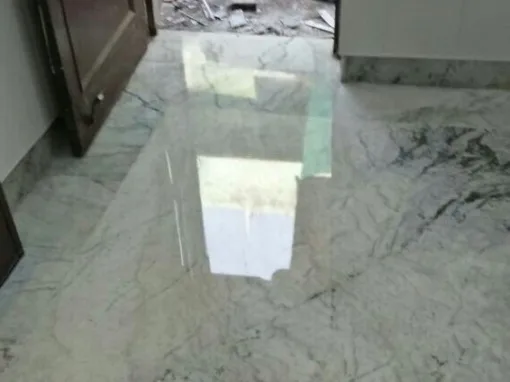
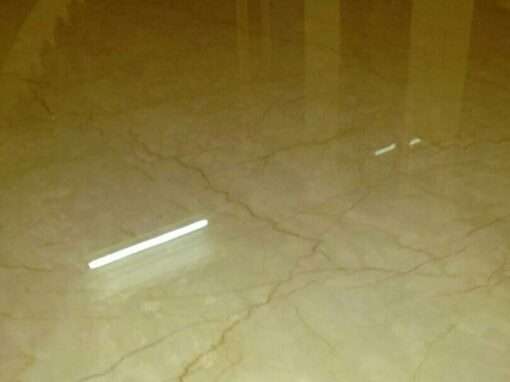
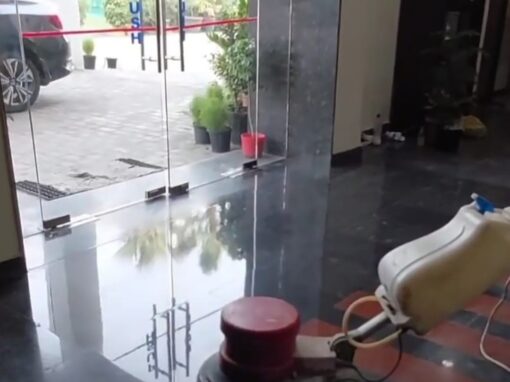
A real before and after photo is added here for the strongest result.
What is included in silicate marble polishing
- Wet grinding to keep dust down indoors
- Coarse to fine grit sequence with no skipped stages
- Slurry contained and vacuumed as we work
- Refining passes to remove grind marks
- Polishing to follow on the same job
- Wash-down and walkthrough
- Free inspection measuring lippage and slab thickness
- Tapping test for hollow slabs
What each surface needs
| Problem | What grinding does | Outcome |
|---|---|---|
| Lippage between slabs | Cuts the high slab to floor level | Flat floor, no trip lines |
| Dark traffic lanes | Removes the compacted worn layer | Uniform colour across the room |
| Deep scratches and gouges | Cuts back below the scratch depth | Gone, or faint on very deep damage |
| Cement, POP and paint splatter | Removes it without acid | Clean stone, no chemical risk |
Every surface is tested on a hidden patch before work starts, so you see the result before committing to the whole floor.
How the job runs
- Inspection, lippage measurement and hollow test (free)
- Masking of walls, skirting, doors and furniture
- Coarse grinding, 40-60 minutes per 100 sq ft
- Refining at 200 and 400 grit, 30-45 minutes per 100 sq ft
- Polishing, wash-down and handover
Silicate Marble Polishing rates in Tripura
| Work | Guide band | Typical case |
|---|---|---|
| Light grinding with polish | Rs 15-25 per sq ft | Surface damage, patchy gloss |
| Full grinding, levelling and polish | Rs 25-35 per sq ft | Lippage, deep damage, dark lanes |
| Crystallisation after grinding | Quoted after inspection | Adds hardness and gloss |
| Grinding plus slab re-laying | Quoted per slab | Hollow or lifted slabs |
Rates depend on surface type, damage depth, area and access. The figure is written down before work begins.
The process, step by step
- Site inspection, gloss reading and hidden test patch
- Masking of skirting, fittings, doors and furniture edges
- Residue and old polish stripping where present
- Grinding if lippage or deep damage is found
- Progressive polishing through the grit sequence
- Optional silicate, crystallisation, epoxy or nano finish
- Edge and corner hand work
- Wash-down, walkthrough and care guidance
Each stage is completed on the whole area before the next one starts, so the floor never ends up with a bright patch next to an unfinished section.
Access is confirmed before the visit: parking, lift use, gate entry, working-hour restrictions and any society paperwork. Sorting this in advance is what stops a scheduled job from becoming a wasted trip.
Old polish, wax and cleaning residue are stripped before any new finish goes on. Layering a fresh treatment over residue is what makes floors look grey again within weeks.
Water and power are the two site requirements. We need one working socket within reach of a lead and a water point; everything else, including masking material and waste bags, comes with the crew.
Why clients book us
- Slab thickness checked before we agree to grind
- Wet grinding with slurry contained and the site washed down
- Same team polishes after grinding, so nothing is blamed on another contractor
- Hollow and thin slabs flagged honestly instead of ground
Serving Tripura and nearby areas
Tripura jobs are booked as a fixed visit batch, so travel is planned into the date instead of being added as a surprise. Work in Tripura is planned as a scheduled visit: the crew and machines travel together on a fixed date, and the rate is written down after the floor is seen in person or from clear photos. Inspections are booked within 24-48 hours and most jobs take 1-2 days. Call 86070 01043 or WhatsApp photos of your floor for an indicative rate.
Silicate Marble Polishing - common questions
Does grinding create dust all over the house?
We grind wet, so dust becomes slurry rather than airborne powder, and we mask doors and skirting. Slurry is vacuumed and washed before we leave.
Can lippage between marble and tile be levelled?
Usually yes where the two surfaces meet at different heights. Where the step is more than a few millimetres, an exact match may not be possible and we say so before starting.
Is grinding always followed by polishing?
Yes in practice. Grinding leaves machine marks until the finer grits and polishing smooth them out, which is why the two stages are quoted together.
What if a slab is hollow?
Grinding cannot re-bond it. Loose slabs must be re-laid, and we quote that separately rather than hiding the problem under a polish.
Will grinding make my floor noticeably thinner?
It removes a fraction of a millimetre at the surface and more only where slabs are high. Average floors take several grinding cycles over their life. We measure thickness during the free inspection first.
How long does each step take?
As a guide, preparation is under an hour, grinding runs 25-40 minutes per 100 sq ft, polishing 15-25 minutes, and finishing plus clean-up about an hour. Bigger areas are scheduled over more days.
Can steps be skipped to save money?
Not safely. Skipping grit stages is the most common shortcut and shows up as scratch haze within weeks. If you want to reduce cost, reduce the area covered this cycle, not the process.
Do you work in one room or the whole floor at a time?
Room by room if you are living in, whole floor if the house is empty, which produces a more even finish because lighting and drying are consistent.