

Granite Restoration in Delhi NCR
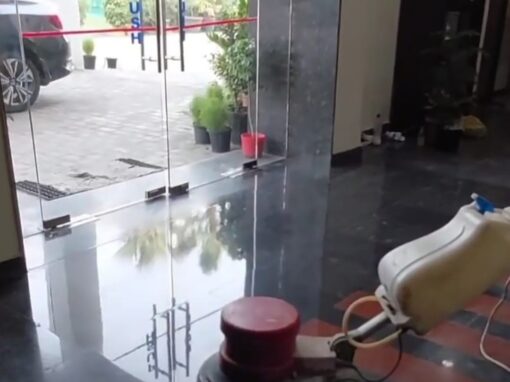
Granite is harder than marble and behaves differently under the machine. It needs its own pad set and a different approach, otherwise the surface turns hazy instead of bright and the mica in the stone starts to look flat. Delhi NCR mixes very old housing stock with new high-rise towers, so a single visit can mean Kota stone in one room and Italian marble in the next. We carry pads for both and quote each surface on its own merit.
- Gloss and polish-condition check first
- Masking of skirting, walls and fittings
- Diamond polishing to the grit the treatment needs
- Even section-by-section silicate application
At a glance
- Granite-specific pads
- Buffing
- Sealing option
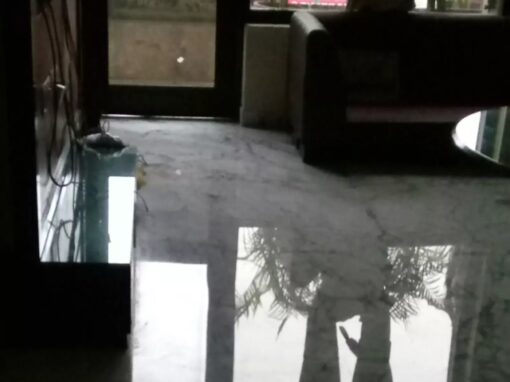
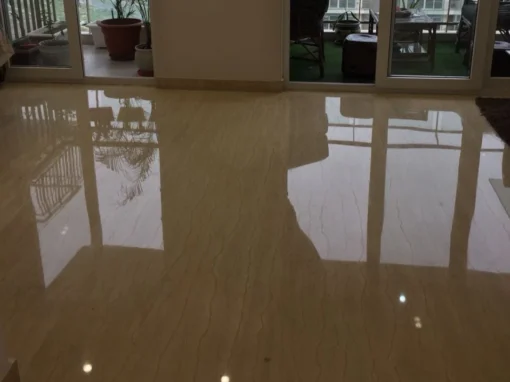
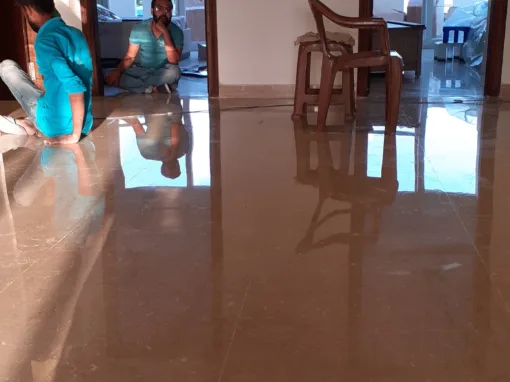
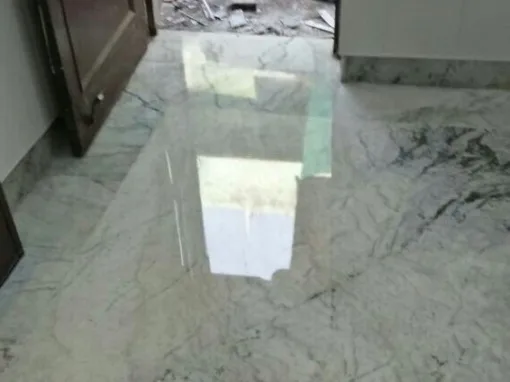
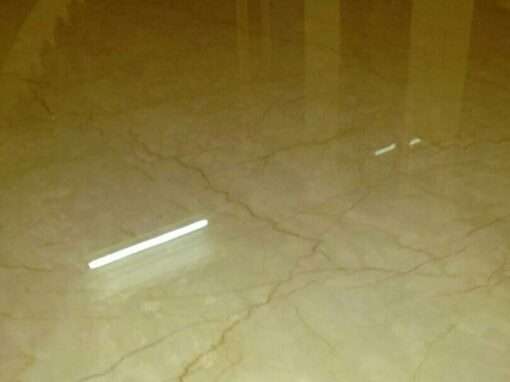
A real before and after photo is added here for the strongest result.
What is included in professional granite restoration
- Diamond polishing to the grit the treatment needs
- Even section-by-section silicate application
- Machine buffing to remove residue and streaks
- Edge and corner treatment by hand
- Walkway protection until the surface sets
- Cleaning advice so acid cleaners never touch it
- Gloss and polish-condition check first
- Masking of skirting, walls and fittings
What each surface needs
| Treatment | Character | Best for |
|---|---|---|
| Sil200 | Fast build, strong initial gloss | Homes and moderate traffic |
| Sil800 | Deeper wet look, holds gloss longer | Lobbies, showrooms, hotels |
| Over new stone | Protects an unworn surface | Recently laid or newly polished floors |
| Over worn stone | Short-lived unless polished first | Only after a full diamond sequence |
Every surface is tested on a hidden patch before work starts, so you see the result before committing to the whole floor.
How the job runs
- Assessment to confirm silicate suits the stone and the room
- Diamond polishing to 800-1500 grit so there is a finish worth locking in
- Silicate applied in sections and buffed while it reacts
- Second pass on heavy areas for even gloss
- Gloss check and a list of cleaners to avoid
Professional Granite Restoration rates in Delhi NCR
| Work | Guide band | Notes |
|---|---|---|
| Polish plus Sil200 | Rs 15-25 per sq ft | Homes, standard traffic |
| Polish plus Sil800 | Rs 25-35 per sq ft | Lobbies, hotels, heavy traffic |
| Silicate over an already polished floor | Quoted after inspection | Floor must still be sound |
| Repeat maintenance treatment | Quoted after inspection | Every 1-3 years |
Rates depend on surface type, damage depth, area and access. The figure is written down before work begins.
The process, step by step
- Site inspection, gloss reading and hidden test patch
- Masking of skirting, fittings, doors and furniture edges
- Residue and old polish stripping where present
- Grinding if lippage or deep damage is found
- Progressive polishing through the grit sequence
- Optional silicate, crystallisation, epoxy or nano finish
- Edge and corner hand work
- Wash-down, walkthrough and care guidance
Each stage is completed on the whole area before the next one starts, so the floor never ends up with a bright patch next to an unfinished section.
Protection is planned, not improvised. Furniture is moved to one side and covered, curtain hems are lifted, and a walking route is kept clear throughout so the household can still move around.
Payment terms are stated upfront: advances apply only where material has to be bought for a large job, and the balance is settled after the walkthrough so you are never paying for work you have not seen.
Old polish, wax and cleaning residue are stripped before any new finish goes on. Layering a fresh treatment over residue is what makes floors look grey again within weeks.
Why clients book us
- Product chosen for the stone, not one bottle for all
- Residue buffed off before handover
- 12 years of stone finishing across Delhi NCR
- We polish before we treat, never over a dull surface
Serving Delhi NCR and nearby areas
Our Badarpur (Mathura Road) and Gurgaon (Badshahpur, Sector 48) teams cover the whole NCR belt. Delhi NCR mixes very old housing stock with new high-rise towers, so a single visit can mean Kota stone in one room and Italian marble in the next. We carry pads for both and quote each surface on its own merit. Inspections are booked within 24-48 hours and most jobs take 1-2 days. Call 86070 01043 or WhatsApp photos of your floor for an indicative rate.
Professional Granite Restoration - common questions
How long does it last?
Roughly two to three years in homes and one to two years in heavy-footfall lobbies. Using a pH-neutral cleaner instead of acid is the biggest factor.
Can it be applied to a floor that was never polished?
It can, but it is rarely worth it, because silicate amplifies whatever surface it meets and locks in scratches. We polish to 800-1500 grit first or refuse the treatment.
Will it make the floor slippery?
A high-gloss finish is smoother when wet. In bathrooms, kitchens and on staircases we recommend a satin or crystallised finish instead of mirror gloss.
How long before we can walk on it?
The floor is walkable the same evening. Only normal drying after the polishing stage is needed, with no curing days.
Is silicate the same as waxing the floor?
No. Wax sits on the surface and wipes off. Silicate reacts with the calcium in the marble and hardens the surface layer, so the gloss is part of the stone and survives mopping.
How long does each step take?
As a guide, preparation is under an hour, grinding runs 25-40 minutes per 100 sq ft, polishing 15-25 minutes, and finishing plus clean-up about an hour. Bigger areas are scheduled over more days.
Can steps be skipped to save money?
Not safely. Skipping grit stages is the most common shortcut and shows up as scratch haze within weeks. If you want to reduce cost, reduce the area covered this cycle, not the process.
Do you work in one room or the whole floor at a time?
Room by room if you are living in, whole floor if the house is empty, which produces a more even finish because lighting and drying are consistent.